What is the purpose of centralizers in drilling?
Centralizers are downhole tools installed on casing or liners to keep the pipe positioned away from the wellbore wall. Their primary purpose is to create a more uniform annular space around the casing so drilling fluid can be displaced more effectively and cement can form a more continuous sheath around the pipe.
In practical well construction, properly selected and placed drilling centralizers support casing running, cementing efficiency, zonal isolation, and long-term well integrity.
Why casing centralization matters
When casing is run into a wellbore without sufficient support, gravity can cause it to rest against the low side of the hole—especially in deviated or horizontal sections. This creates a narrow annulus on one side and a wider gap on the other.
During cementing, fluids tend to move through the path of least resistance. If the casing is poorly centralized, drilling mud may remain trapped in the narrow side of the annulus, while cement flows mainly through the wider side. The result can be incomplete mud removal, uneven cement placement, and potential channels in the cement sheath.
Centralizers help maintain casing stand-off from the borehole wall, creating a more balanced annular clearance for fluid displacement and cement placement.
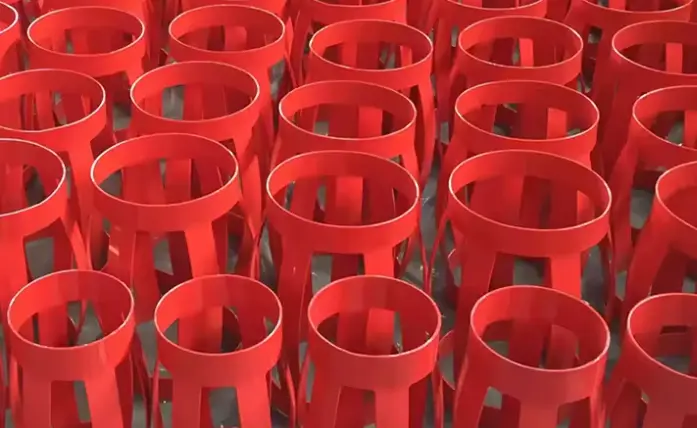
Main purposes of drilling centralizers
1. Keep casing centered in the wellbore
The most direct function of a centralizer is to hold casing or liner closer to the center of the wellbore. This is particularly important in deviated, extended-reach, and horizontal wells, where pipe naturally tends to lie on the low side.
Better centralization provides more even space around the casing and supports a more reliable cementing operation.
2. Improve cement displacement efficiency
A uniform annulus helps spacer fluid and cement slurry move around the full circumference of the casing. This improves the likelihood of removing drilling fluid from critical intervals before cement sets.
Effective cement placement supports:
- Better cement-to-formation contact
- Better cement-to-casing bonding
- Reduced risk of mud channels
- More consistent annular sealing
3. Support zonal isolation
Zonal isolation prevents unwanted fluid communication between different underground formations. If cement does not fully surround the casing, oil, gas, water, or other formation fluids may find pathways through poorly cemented sections.
By improving casing stand-off, drilling centralizers help create the conditions needed for a more continuous cement barrier. They are an important part of the broader well-integrity system, alongside proper hole cleaning, fluid design, cement slurry design, and placement procedures.
4. Reduce drag and running risks
Centralizers can reduce direct contact between casing and the wellbore wall. In suitable well conditions, this may help lower drag while running casing and reduce the likelihood of the pipe hanging up in tight spots, key seats, or irregular hole sections.
However, centralizers must be selected carefully. A tool with excessive running force or unsuitable outside diameter can increase drag rather than reduce it.
5. Help protect casing during installation
Keeping casing away from the borehole wall can reduce localized contact and wear during installation. This is valuable in long casing strings and challenging trajectories where friction, torque, and mechanical loads require close engineering attention.
How centralizers work
A centralizer is mounted around the casing and creates outward support against the wellbore wall or previous casing string. Its restoring force helps push the casing toward the center of the annulus.
The design must balance two important factors:
| Performance factor | Why it matters |
|---|---|
| Restoring force | Helps maintain casing stand-off and centralization |
| Starting and running force | Affects how easily the casing string can pass through restrictions and reach target depth |
| Outside diameter | Must suit the open-hole or cased-hole section |
| Tool spacing | Determines how well the casing is supported between centralizers |
| Material compatibility | Must withstand drilling fluids, cementing fluids, temperature, pressure, and mechanical loads |
Too few centralizers may allow casing sag between tools. Too many, or poorly selected tools, may create excessive drag. A proper centralization plan evaluates the well trajectory, hole size, casing size, annular clearance, fluid conditions, and cementing objectives.
Common types of drilling centralizers
Bow-spring centralizers
Bow-spring centralizers use flexible steel bows to provide restoring force. They are often suitable for open-hole intervals and sections with changing hole diameters.
Their flexibility can help them pass through restrictions and adapt to enlarged hole conditions. Their performance depends on bow geometry, material quality, restoring force, and the actual wellbore profile.
Rigid centralizers
Rigid centralizers use solid blades or ribs to maintain stand-off. They are often used in relatively gauge hole sections or cased-hole intervals where positive spacing is required.
Compared with flexible designs, rigid centralizers may provide stronger and more predictable stand-off in the right application, but they require careful consideration of clearance and running conditions.
Semi-rigid centralizers
Semi-rigid designs provide a middle ground between flexible bow-spring and rigid-blade centralizers. They may be selected where the well requires dependable restoring force while still needing reasonable passage through restrictions.
Rotating centralizers
Rotating centralizers are designed to reduce friction between the casing and the wellbore or previous casing. They may be useful in certain high-angle or horizontal applications where casing rotation or reciprocation is part of the running and cementing strategy.
Where should centralizers be placed?
Centralizer placement should not be based on a simple fixed spacing rule. The required number and location depend on the actual well design and operational objectives.
Critical intervals often include:
- Zones requiring reliable cement isolation
- Highly deviated or horizontal sections
- Narrow annulus sections
- Areas near casing shoes and liner tops
- Sections with known washouts, ledges, or potential key seats
- Intervals where casing movement is expected during cementing
Engineering teams commonly use centralization simulations to estimate casing stand-off, pipe sag, running forces, and placement performance before the casing string is run.
What happens if centralization is poor?
Poor centralization can contribute to several cementing and well-construction problems:
- Uneven cement distribution around casing
- Incomplete drilling-fluid displacement
- Mud channels or contaminated cement
- Weak zonal isolation
- Increased risk of fluid migration
- Higher casing drag in difficult intervals
- Reduced confidence in long-term well integrity
A centralizer cannot solve every drilling or cementing issue on its own. Hole cleaning, wellbore condition, drilling fluid properties, spacer compatibility, cement design, pumping rates, and operational execution all affect the final result. Still, effective centralization is one of the essential foundations of a successful cement job.
How to select the right centralizer
Before selecting a centralizer, consider the full downhole environment rather than focusing only on pipe size.
Key selection factors include:
- Casing or liner outside diameter
- Open-hole diameter and hole condition
- Previous casing inside diameter where applicable
- Well inclination and dogleg severity
- Expected temperature and pressure
- Drilling fluid and cement-system compatibility
- Required stand-off in critical cementing intervals
- Restriction sizes and running clearance
- Desired rotation or reciprocation capability
- Centralizer placement and stop-collar requirements
The right design should provide adequate restoring force while allowing the casing string to reach planned depth safely and efficiently.
Conclusion
The purpose of centralizers in drilling is to keep casing or liners properly positioned within the wellbore. By improving annular clearance and casing stand-off, they support better drilling-fluid displacement, more uniform cement placement, reduced operational friction, and stronger zonal isolation.
For demanding well conditions, centralizer choice and placement should be part of the overall casing and cementing design—not an afterthought. A well-engineered plan considers the actual trajectory, annular geometry, formation conditions, fluid system, and operational limits.
For centralizer-related products or project discussions, you can contact our team through JF Anchor Bolt.
FAQ
What are drilling centralizers used for?
Drilling centralizers are used to keep casing or liners away from the wellbore wall. They help create a more even annular space, which supports drilling-fluid displacement and cement placement.
Do centralizers improve cementing quality?
They can improve the conditions for quality cementing by increasing casing stand-off and reducing the chance of narrow annular gaps where drilling fluid may remain. Final cementing quality also depends on wellbore condition, fluid design, and operational execution.
Are bow-spring centralizers and rigid centralizers the same?
No. Bow-spring centralizers use flexible bows and can adapt to varying hole conditions, while rigid centralizers use solid blades to provide more positive stand-off in suitable intervals.
How many centralizers are needed on a casing string?
The required quantity depends on the well trajectory, casing size, hole size, critical cementing intervals, expected stand-off, and running-force limits. A centralization simulation is often used to develop the placement plan.