What Are Tapered Drill Rods Used For? Applications & Selection Guide
Tapered drill rods are primarily used in small-hole, top-hammer rock drilling. They transmit impact energy and rotation from a rock drill to a compatible tapered drill bit, allowing operators to create holes in rock for blasting, anchoring, splitting, excavation, and site preparation.
Because they use a tapered connection rather than a threaded connection at the bit end, tapered drill rods are commonly selected for handheld and air-leg drilling applications where fast bit changes, practical operating costs, and dependable performance matter. They are widely used in quarrying, mining, tunneling, road construction, and other rock-excavation work.
How Do Tapered Drill Rods Work?
A tapered drill rod sits between the rock drill and the drill bit. The shank end connects to the drill, while the tapered end holds a matching bit. During operation, the rock drill delivers repeated impact energy and rotation through the rod to the bit.
The tapered fit helps create a secure connection between the rod and bit during drilling. When the system is correctly matched, the rod transfers energy efficiently and helps the bit break rock at the bottom of the hole.
A typical drilling system includes:
- A pneumatic or hydraulic rock drill
- A tapered drill rod
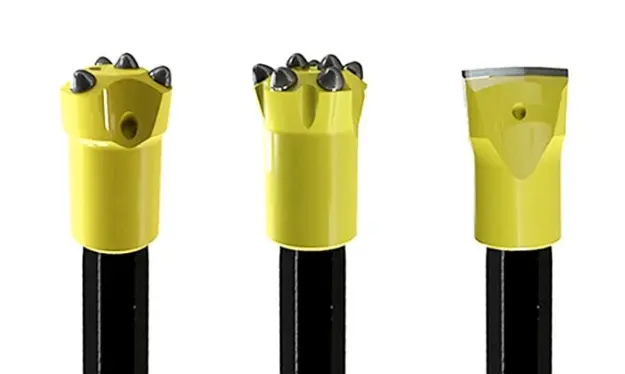
- A compatible tapered button bit or cross bit
- Compressed air or flushing support, depending on the drilling method
- A suitable operating procedure for the rock type and hole requirement
The rod does not work as a standalone tool. Its performance depends on the compatibility of the entire drilling system.
Main Applications of Tapered Drill Rods
Quarrying and Dimension Stone Drilling
In quarries, tapered drill rods are often used to drill smaller holes in granite, limestone, marble, and other rock formations. These holes may support controlled splitting, block extraction, secondary breaking, or preparation for blasting.
For quarry operators, straight and correctly positioned holes are important because drilling accuracy can affect material recovery, safety, and downstream processing efficiency.
Mining Operations
Tapered drill rods are widely used in underground and surface mining for small-diameter rock drilling. Typical tasks include blast-hole drilling, development work, orebody access, and secondary rock breaking.
They are particularly practical in operations that use handheld rock drills, air-leg drills, or compact drilling equipment. The ability to replace a worn bit without replacing the entire rod can also help control consumable costs.
Tunneling and Civil Construction
Construction and tunneling projects often require drilling into rock for excavation, support work, and controlled blasting. Tapered drill rods can be used in smaller-scale rock drilling where mobility and operational flexibility are important.
Typical uses include road cutting, railway construction, utility corridors, slope stabilization, foundation preparation, and tunnel development.
Rock Anchoring and Ground Support Preparation
In some projects, drilling is required before anchors, bolts, or other support elements can be installed. While the final drilling method depends on hole depth, diameter, ground conditions, and engineering requirements, tapered drill rods may be suitable for certain shallow or small-hole preparation tasks.
Operators should always confirm the required hole specification, drilling depth, and tool compatibility before selecting the drilling system.
Why Choose Tapered Drill Rods?
One key advantage of tapered drill rods is their simple bit-changing system. When a bit becomes worn or when drilling conditions change, the operator can replace the bit while continuing to use the same rod, provided the connection is compatible and the rod remains in serviceable condition.
Other potential advantages include:
- Suitable for small-hole top-hammer drilling
- Practical for handheld and air-leg rock drills
- Available in multiple lengths and steel sizes
- Compatible with different bit styles for varying rock conditions
- Useful for quarrying, mining, construction, and tunneling work
- Can reduce unnecessary replacement of complete drilling assemblies
However, a tapered system is not automatically the best choice for every job. Deep-hole drilling, larger diameters, high-production drilling, or highly specialized ground conditions may require a different drilling tool system.
Taper Angle Compatibility Matters
One of the most important selection factors is the taper angle. Common tapered connections include 7°, 11°, and 12°, although available configurations can vary by manufacturer and market.
A tapered bit must match the rod’s taper angle. For example, an 11° tapered bit should be used with an 11° tapered rod designed for that connection. The same rule applies to other taper angles.
Do not assume that rods and bits are interchangeable simply because they appear similar. A mismatch can reduce connection security, affect energy transfer, increase wear, and create avoidable operating issues.
Before ordering tapered drill rods, confirm:
| Selection Factor | Why It Matters |
|---|---|
| Taper angle | The bit and rod must use the same taper connection. |
| Rod steel size | The rod section must suit the rock drill and drilling duty. |
| Shank type | The shank must fit the specific rock drill model. |
| Rod length | Length should match the required drilling depth and working space. |
| Bit type | Button bits and cross bits may suit different rock and application conditions. |
| Bit diameter | The hole diameter must meet the blasting, anchoring, or construction requirement. |
| Rock condition | Hardness, abrasiveness, fracturing, and ground behavior affect tool choice. |
How to Select the Right Tapered Drill Rod
The best tapered drill rod is not simply the longest or heaviest option. It is the one that fits the drill, bit, hole requirement, and working conditions as a complete system.
Start by identifying the rock drill model and its shank requirement. Then confirm the taper angle, rod length, steel section, and required bit diameter. If the application involves abrasive or hard rock, ask the supplier about suitable heat treatment, bit configuration, and expected wear characteristics.
It is also important to consider maintenance. Inspect rods regularly for visible cracking, excessive wear at the shank or tapered end, deformation, and poor bit fit. Continuing to use a damaged rod can affect drilling quality and may shorten the service life of other components.
Tapered Drill Rods vs. Integral Drill Steels
Tapered drill rods are different from integral drill steels. An integral drill steel has the bit formed as part of the steel, so the bit cannot be replaced separately. A tapered rod, by contrast, uses a removable tapered bit.
This makes tapered drill rods a flexible option when operators want to change bit types or replace worn bits without replacing the entire drill steel. The right choice depends on the drilling method, maintenance preference, application scale, and total operating cost.
Final Thoughts
Tapered drill rods are used to transfer impact and rotation from a rock drill to a tapered drill bit in small-hole rock drilling operations. Their main applications include quarrying, mining, tunneling, construction, and other projects requiring reliable drilling in rock.
For best results, treat the rod, bit, rock drill, and drilling conditions as one matched system. Confirm the taper angle, shank style, rod dimensions, bit type, and application requirements before purchasing.
If you need support selecting rock-drilling tools or related anchoring products for your project, please contact our team.
FAQ
What is the main purpose of a tapered drill rod?
Its main purpose is to connect a rock drill to a tapered drill bit and transfer impact energy and rotation for small-hole rock drilling.
Are tapered drill rods used in mining?
Yes. They are commonly used in mining, especially for smaller-hole drilling with handheld, air-leg, and compact top-hammer rock-drilling equipment.
Can I use any tapered bit with any tapered drill rod?
No. The taper angle, rod size, and connection details must be compatible. Always confirm the exact taper specification before ordering replacement bits.
What is the difference between a tapered drill rod and a threaded drill rod?
A tapered drill rod uses a tapered bit connection, while a threaded drill rod uses a threaded connection. The appropriate choice depends on the drill type, hole depth, production requirement, and operating conditions.