Best Screw Anchors for Hollow Core Doors: A Practical Installation Guide
The best screw anchors for hollow core doors are lightweight hollow-door anchors designed to grip the thin door skin without relying on solid wood behind the surface. For mirrors, hooks, small signs, and light hardware, plastic hollow-wall anchors, self-drilling drywall anchors, and hollow-door expansion anchors can work well. For heavy shelves, large cabinets, or safety-critical hardware, a hollow core door may not provide enough structural strength and should be reinforced or replaced with a solid-core door.
Choosing the right screw anchors is important because a hollow core door is constructed differently from a solid wood door. The outer skins are relatively thin, while the interior is mostly lightweight honeycomb or foam material. A normal wood screw may appear secure at first but can pull out when the door is loaded, opened repeatedly, or exposed to vibration.
What Is a Hollow Core Door?
A hollow core door is an interior door made with thin wood, wood-fiber, or composite skins attached to a lightweight internal structure. The core may contain:
-
Cardboard or paper honeycomb
-
Foam
-
Lightweight fiberboard
-
Small reinforcement blocks around the edges
-
A solid area near the lockset or hinge locations
The main advantage of a hollow core door is its low weight and affordable cost. The limitation is that most of the door surface cannot hold a conventional screw in the same way as solid timber.
This means the screw anchor must spread the load across a larger area or lock behind the door skin.
What Are the Best Screw Anchors for Hollow Core Doors?
The best option depends on the weight and type of item being mounted.
1. Plastic Hollow Door Anchors
Plastic hollow-door anchors are designed to expand behind the door skin. They are suitable for lightweight applications such as:
-
Small hooks
-
Lightweight signs
-
Door decorations
-
Small towel holders
-
Light switches or accessories
-
Small picture frames
These anchors are affordable and easy to install. However, their load capacity is limited, and they should not be used for items that will be pulled, swung, or frequently moved.
2. Self-Drilling Drywall Anchors
Self-drilling drywall anchors have a sharp or threaded point that allows them to penetrate the surface without a large pilot hole. They are convenient for light-duty mounting.
Although they are commonly used in drywall, some self-drilling screw anchors can also be used on hollow door skins when the manufacturer permits it. The installer should check:
-
The thickness of the door skin
-
The anchor’s minimum material thickness
-
The screw diameter
-
The expected load
-
Whether the anchor requires a hollow cavity behind the surface
Self-drilling anchors are not ideal for heavy or high-impact applications because the holding strength depends heavily on the thin door skin.
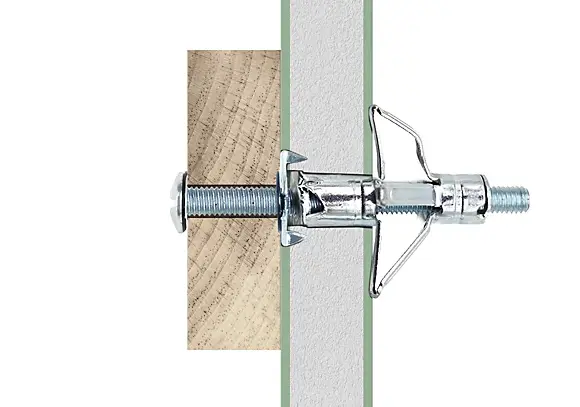
3. Hollow-Wall Expansion Anchors
Hollow-wall expansion anchors use a metal or plastic body that opens behind the door surface. Once expanded, the anchor creates a larger bearing area and distributes the load.
These screw anchors are often more reliable than a basic plastic plug for medium-light applications. They may be suitable for:
-
Medium-weight hooks
-
Small wall-mounted organizers
-
Lightweight hardware
-
Interior signs
-
Small mirrors, when properly supported
Installation must be controlled carefully. Over-tightening can crush the door skin or deform the anchor, reducing its holding capacity.
4. Toggle-Style Anchors
Toggle anchors use wings, straps, or a folding mechanism that opens behind the hollow surface. They distribute the load over a relatively large area and can provide stronger holding power than simple screw-in anchors.
However, toggle anchors require sufficient clearance inside the door. The interior honeycomb structure may block the mechanism from opening properly. They may also require a larger hole, which can make installation and future repair more difficult.
Toggle-style screw anchors should be used only after confirming that the door construction allows the wings or toggle to deploy correctly.
5. Molly-Style Hollow Door Anchors
Molly bolts are metal hollow-wall anchors that expand behind the surface when tightened. They can provide a firm attachment point for medium-duty hardware.
They are useful when:
-
The door skin is strong enough
-
The anchor size matches the material thickness
-
The load is not subject to repeated impact
-
The anchor can be installed without damaging the door structure
Molly-style anchors are stronger than many basic plastic anchors, but they still cannot turn a hollow core door into a solid structural panel.
Which Screw Anchors Should You Avoid?
Several common fastening methods are unsuitable for hollow core doors.
Standard Wood Screws Without an Anchor
A wood screw needs solid material around its threads. On a hollow core door, a standard screw may only grip the thin skin. It can loosen or pull out when the mounted item is loaded.
Drywall Plugs Used Without Checking Compatibility
A drywall plug is not automatically suitable for a hollow door. Door skins may differ from gypsum board in thickness, hardness, and internal clearance. Always verify that the anchor is approved for the actual substrate.
Oversized Anchors
An oversized anchor may weaken the surface by removing too much material. It can also crush the door skin or leave a large hole that is difficult to repair.
Anchors Installed Too Close to the Edge
The edges of a hollow core door may contain structural rails, but drilling near the edge can split the skin or interfere with the frame. The exact construction varies by manufacturer, so the installer should locate the intended mounting point carefully.
Anchors Used for Safety-Critical Loads
Hollow core doors are generally not suitable for grab bars, heavy shelves, large wall cabinets, child safety equipment, or equipment that people may pull on. For these applications, use a solid-core door, add internal reinforcement, or transfer the load to the surrounding frame or wall.
How Much Weight Can Screw Anchors Hold in a Hollow Core Door?
There is no universal weight rating for hollow door anchors. The actual holding capacity depends on:
-
Anchor design
-
Door skin material
-
Door skin thickness
-
Screw size
-
Installation quality
-
Distance from the edge
-
Direction of the load
-
Repeated movement or vibration
-
Condition of the door
-
Shape of the mounted item
A static load that hangs straight down is usually less demanding than a load that pulls outward from the door. A hook holding a coat may create a repeated pulling force every time the item is removed. A door-mounted organizer may also produce leverage that increases stress on the anchors.
For safety, use the manufacturer’s tested load rating and maintain a clear margin below that rating. Do not treat an advertised maximum as a recommended everyday working load.
How to Install Screw Anchors in a Hollow Core Door
A careful installation usually follows these steps.
Step 1: Confirm the Door Construction
Check that the mounting location is actually hollow and that it does not contain wiring, hardware, or a solid reinforcement block. Avoid drilling into hinges, lock components, or areas that may contain internal framing.
Step 2: Mark the Mounting Location
Measure the position carefully and use a level where necessary. A misplaced hole may be difficult to repair because hollow core doors have limited material for patching.
Step 3: Select the Correct Anchor Size
Match the anchor to:
-
The door skin thickness
-
The screw diameter
-
The expected load
-
The available cavity depth
-
The manufacturer’s installation instructions
Do not substitute a different screw simply because it fits the visible opening. Thread length and screw head shape can affect the anchor’s expansion.
Step 4: Drill the Pilot Hole
Use the recommended drill bit size and keep the drill perpendicular to the door surface. Excessive pressure can damage the thin skin or create a hole larger than intended.
Step 5: Insert and Expand the Anchor
Install the anchor according to its design. Some screw anchors are driven directly into the surface, while others require insertion before the screw is tightened.
Do not force the anchor if internal honeycomb material blocks it. A blocked anchor may not expand correctly and may provide little holding strength.
Step 6: Tighten Carefully
Tighten the screw until the hardware is secure. Stop when the anchor is fully engaged. Over-tightening can crush the skin, deform the anchor, or pull the anchor through the surface.
Step 7: Test the Installation Gradually
Apply a light load first. Check for movement, cracking, surface deformation, or loosening. Increase the load gradually rather than applying the full load immediately.
How Can You Improve the Holding Strength?
When more strength is required, consider one of these solutions:
-
Use a larger load-distributing anchor approved for the door skin.
-
Install a mounting plate that uses multiple anchors.
-
Fasten into a solid edge rail where appropriate.
-
Add a reinforcement block inside the door.
-
Transfer the load to the wall or door frame.
-
Replace the hollow core door with a solid-core door.
-
Use a through-bolt with suitable washers if both sides of the door are accessible.
A mounting plate can reduce stress on each individual anchor, but it does not eliminate the structural limitations of the door. The mounting plate, screws, anchors, and door skin must be evaluated as one system.
Screw Anchors vs. Through-Bolts
Through-bolts can provide stronger connections because they pass through the door and are secured with a washer and nut on the opposite side. However, they are not always practical.
Potential limitations include:
-
The back of the door may be visible
-
The door may not have enough clearance
-
The bolt may interfere with closing
-
The door surface may be damaged
-
The hardware may be inconvenient to remove
For medium-duty mounting where appearance is not a concern, a properly sized through-bolt can be more secure than a surface-installed anchor. For clean interior appearance, a purpose-made hollow-door anchor may be preferable for light loads.
How Do You Choose Between Plastic and Metal Screw Anchors?
Plastic anchors are generally suitable for light loads and simple installations. They are corrosion-resistant, inexpensive, and easy to replace.
Metal screw anchors may provide greater strength and durability, particularly where the hardware is installed and removed repeatedly. However, metal anchors can damage the door skin if over-tightened and may require a more precise installation.
Choose based on the application rather than assuming that metal is always better. The strongest anchor is not useful if it is incompatible with the door skin or cannot expand correctly inside the cavity.
Can Screw Anchors Be Used on Commercial or Fire-Rated Doors?
Commercial doors, fire-rated doors, acoustic doors, and security doors may have specialized cores and certification requirements. Drilling into these doors can affect their performance or invalidate the manufacturer’s certification.
Before installing screw anchors on a rated or commercial door, check the door manufacturer’s instructions and any applicable building requirements. For fire, smoke, security, or accessibility-related hardware, use approved installation methods and qualified professionals.
What Should You Ask a Screw Anchor Supplier?
When sourcing screw anchors for manufacturing, construction, door hardware, or distribution, ask the supplier for:
-
Anchor material
-
Surface treatment
-
Recommended screw size
-
Compatible substrate thickness
-
Pull-out test data
-
Shear-load test data
-
Torque requirements
-
Corrosion-resistance information
-
Installation instructions
-
Packaging and labeling options
-
OEM or customized production capability
A professional supplier should be able to explain not only the anchor dimensions but also how the product performs in the intended substrate.
Can JF Anchor Bolt Help With Anchor Sourcing?
JF Anchor Bolt is a manufacturer and supplier of anchoring-related products and support systems, including anchor bolts, resin anchoring agents, split bolt mining systems, tunneling drilling tools, and anchoring support solutions.
For projects involving customized screw anchors, industrial fastening components, OEM production, or larger-volume sourcing, you can contact JF Anchor Bolt to discuss the required material, dimensions, surface treatment, load conditions, and application environment.
When requesting a quotation, provide:
-
Product drawings or dimensions
-
Required screw and anchor size
-
Base material or substrate type
-
Expected load
-
Indoor or outdoor service conditions
-
Corrosion requirements
-
Surface treatment
-
Required quantity
-
Packaging requirements
Clear technical information helps the supplier determine whether a standard product or a customized anchoring solution is more suitable.
Frequently Asked Questions
What are the best screw anchors for a hollow core door?
For light-duty applications, plastic hollow-door anchors or self-drilling anchors may be suitable. For medium-light loads, hollow-wall expansion anchors or metal molly-style anchors may provide better load distribution. Always check the door skin thickness and the anchor’s tested rating.
Can I use drywall anchors in a hollow core door?
Some drywall anchors can be used, but not all are suitable. Confirm that the anchor is designed for the door skin material and thickness before installation.
Can I hang a heavy mirror on a hollow core door?
A small, lightweight mirror may be supported with suitable screw anchors. A large or heavy mirror should be attached using a reinforced mounting system, a through-bolt, or a solid-core door.
Are self-tapping screws strong enough for hollow doors?
A self-tapping screw alone usually provides limited holding strength because it has very little solid material to engage. It is more reliable when used with a compatible hollow-door anchor.
Should I use more anchors to hold more weight?
Using multiple anchors can distribute the load, but it does not remove the structural limitations of the door. The door skin, anchor spacing, hardware, and load direction must all be considered.
Final Recommendation
The best screw anchors for hollow core doors are purpose-made anchors selected according to the door skin, load, installation location, and expected use. Plastic hollow-door anchors are suitable for light items, while expansion anchors, molly-style anchors, or toggle-style anchors may be better for medium-light applications when the internal cavity allows proper deployment.
For heavy, safety-critical, or frequently loaded hardware, do not rely on a hollow core door alone. Use reinforcement, through-bolts, a solid-core door, or a connection to the surrounding frame.
The most reliable result comes from matching the screw anchors to the actual substrate and verifying the installation under realistic loading conditions.