
Product
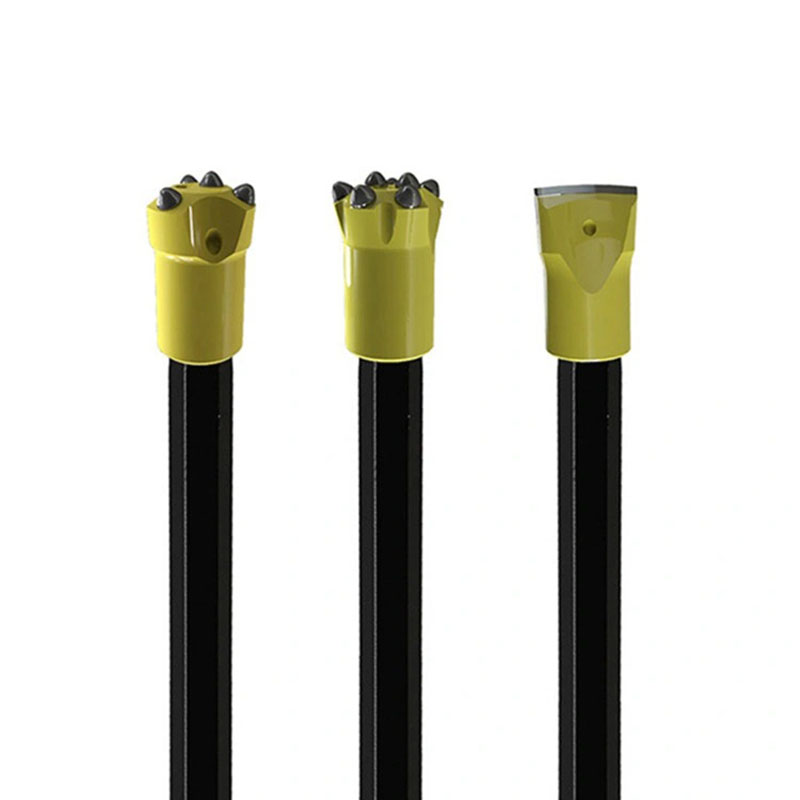
Carbide Tipped Tapered Drill Rod for Efficient Rock Penetration
A tapered drill rod is a drilling tool used with handheld pneumatic rock drills. It connects to a tapered drill bit via a tapered interference fit and is primarily used for drilling small-diameter holes. It is widely used in mining, quarrying, tunnel engineering, water well drilling, and foundation construction.
I. Manufacturing Process
Raw Materials: Large cross-section continuously cast billets (e.g., 320×480mm)
Forming: Through drilling, hot rolling, forging, and other processes
Heat Treatment: Quenching and tempering (quenching + high-temperature tempering), normalizing
Hardness Standard: Normalized state HRC32-35, Quenched and tempered state HRC49-57
II. Quality Grades (Classified by rock hardness coefficient f value)
Grade | Applicable Rock | Hardness Coefficient f
Superior Grade | Extremely hard rock | f ≥ 12 (Grade III and above)
Excellent Grade | Hard rock | f ≥ 12 (Grade IV and above)
Ordinary Grade | Medium hard and below | f ≤ 8 (Grade IV and below)
III. Usage Instructions
Must be used with a tapered drill bit.
The tapered drill rod itself does not have drilling capability and must be used with a tapered drill bit. Drill bit types include:
Chisel Bit: Suitable for soft to medium-hard rocks, high drilling speed
Cross Bit: Suitable for medium-hard to hard rocks, good wear resistance
Button Bit: Suitable for high-hardness, highly abrasive rocks, long service life
⚠️ Core Rule: The taper angles of the drill rod and drill bit must be consistent (e.g., a 7° drill rod must be paired with a 7° drill bit).
IV. Applicable Equipment
Mainly compatible with handheld pneumatic rock drills, such as models YT29, YT27, and YT28.
V. Selection Principles
Select the appropriate taper drill pipe based on the operating conditions:
Soft rock (f ≤ 8): Standard grade drill pipe + flathead drill bit, 7° taper
Medium-hard rock (f 8-12): Premium grade drill pipe + crosshead drill bit, 7° or 11° taper
Hard rock (f ≥ 12): Superior grade drill pipe + ball-tooth drill bit, 11° or 12° taper
Deep hole operations (>3m) Prefer H22 or higher specifications to ensure rigidity.
VI. Usage and Maintenance Points
Usage Precautions
Taper Fit Check: Ensure the drill rod and drill bit taper are consistent and tightly fitted to prevent loosening during operation.
Manual Pre-tightening: Tighten manually during installation; do not use the drilling machine to directly impact installation to prevent damage.
Matching Principle: The drill bit diameter should be larger than the drill rod diameter.
Abnormal Handling: If the drill gets stuck or jammed, stop drilling immediately or reverse the drill and slowly advance to prevent the drill rod from bending and deforming.
Maintenance Specifications
Regular Maintenance: Perform rust and dust prevention treatment according to the specified cycle.
Post-Operation Cleaning: After working in acidic or alkaline environments, clean the rod surface with clean water promptly to remove the corrosion layer.
Scrap Standard: Drill rods with excessive bending or damaged threads that cannot operate normally should be scrapped or returned to the factory for repair.
Storage Requirements
Store in a dry environment with multiple support points at the bottom.
Do not pile them randomly under gravel or coal piles.
After maintenance and cleaning, cover with a protective cap or pack and seal.
VII. Common Specification Quick Reference Table
Parameters
Common Specifications
Taper Angle
4°46′ / 6° / 7° / 11° / 12°
Hexagonal dimensions: H19 / H22 / H25
Handle dimensions: 19×108 / 22×108 / 22×159 / 25×108 / 25×159 (mm)
Length range: 0.4m – 10m
Material: 55SiMnMo / 95CrMo / 23CrNi3Mo
Weight per piece: 1.7kg – 25kg (depending on length)